
THE QUICK ANSWER: Freelancers for niche needs and low budgets. Agencies for volume, expertise, and hands-off support.
Choosing between a content writing agency and a freelancer for your needs can be tricky, as both offer distinct advantages and disadvantages.
Our guide makes it simpler.
When to choose which (Content Writing)
1. Agency
- You need a large volume of content consistently.
- You require diverse expertise for different writing styles, SEO optimization, and editing.
- You have a high budget and prefer a hands-off approach.
2. Freelancer
- You have a smaller project with a tight budget.
- You need specific niche skills not readily available in an agency.
- You value personal collaboration and direct communication with the writer.
- You need more flexibility to adapt to changing project requirements.
Carefully weigh the pros and cons of each option before making a decision.
Differences: Agency vs Freelancer (Content Writing)
| Feature | Content Writing Agency | Freelancer |
|---|---|---|
| Cost | $$$ | $ |
| Expertise | Broad range of skills and specializations | Niche expertise, may require finding the right fit |
| Scalability | Can handle large projects with high volume | May struggle with large projects or tight deadlines |
| Personalization | Less personal touch, communication through intermediaries | Direct communication and collaboration with the writer |
| Flexibility | Less flexible due to established processes | More adaptable to specific needs and changes |
| Project Management | Agency takes care of logistics | You handle communication, logistics, and quality control |
Let’s go in-depth on this.
1. Structure → Team
- Agency: A team of writers, editors, designers, and strategists working together under one roof. Offers a full-service package, handling research, writing, editing, publishing, and SEO.
- Freelancer: Solo individual offering writing services. May collaborate with freelancers for other aspects like editing or design, but project management falls on you.
2. Expertise
- Agency: Access to a wider range of skills and expertise covering diverse writing styles and industry niches. Can manage complex projects requiring multiple specialists.
- Freelancer: May have specialized skills in a specific niche but might lack broader expertise. Finding freelancers for different aspects of your project requires more effort.
3. Cost
- Agency: Higher fees due to overhead costs. Offers scalability as they can handle growing content needs by adding team members.
- Freelancer: Usually more affordable for smaller projects, but rates can vary depending on experience. Scaling requires finding and onboarding additional freelancers, which can be time-consuming.
4. Communication & Control
- Agency: Less direct communication with the writer as you interact with a project manager. May follow stricter internal processes and guidelines.
- Freelancer: Direct communication with the writer allows for a more personalized approach and greater control over the project.
Advantages & Disadvantages (For Each)
1. Agency
Advantages:
- Full-service solution: Agencies handle everything from strategy and ideation to writing, editing, and publishing. You don’t need to manage the project yourself.
- Scalability: They can handle large projects and ongoing content needs seamlessly, growing their team to match your requirements.
- Broad expertise: Access to a diverse range of writers with skills in various writing styles and industry niches.
- Streamlined process: Standardized processes and workflows ensure consistent quality and delivery.
- Project management: Dedicated project managers ensure deadlines are met and communication is smooth.
Disadvantages:
- Cost: Typically more expensive than freelancers due to overhead and team costs.
- Less personal touch: Direct communication with the writer might be limited, making it harder to personalize your content.
- Less flexibility: May have set packages or minimum project requirements, offering less customization.
- Potential lack of understanding of your brand: It might take more effort to onboard them on your specific brand voice and tone.
2. Freelancer
Advantages:
- Cost-effective: Often charged by the project or hour, making them a more affordable option for smaller budgets.
- Personal touch: Direct communication with the writer allows for greater control over the project and easier personalization.
- Flexibility: Easier to find freelancers with specific skills or experience relevant to your niche.
- Potential deeper understanding of your brand: Freelancers can immerse themselves in your brand and tailor content accordingly.
Disadvantages:
- Limited resources: May lack access to editors, designers, or SEO experts, requiring you to find these services separately.
- Project management: You’ll be responsible for managing the project, including finding the right freelancer, setting deadlines, and providing feedback.
- Scalability: Finding and onboarding multiple freelancers for large projects can be time-consuming and challenging.
- Quality consistency: Depending on the freelancer, the quality and style of content might vary.
Ultimately, the best choice depends on your specific needs and priorities.
For smaller projects, tight budgets, and a need for personalized content, a freelancer might be ideal.
For larger projects, ongoing content needs, and wanting a hands-off approach, an agency could be the better fit.
Tips: Finding & Hiring the right agency/freelancer
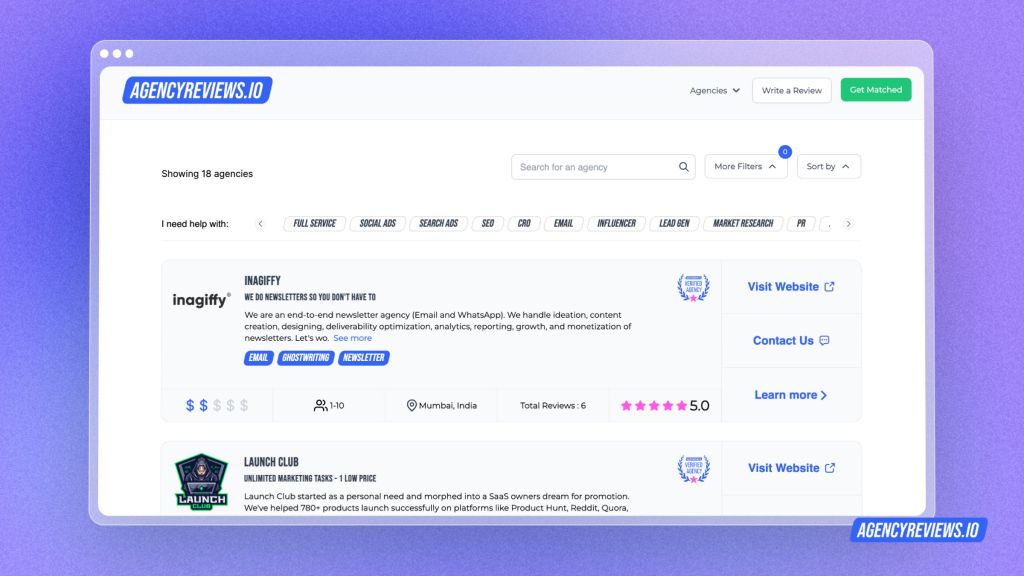
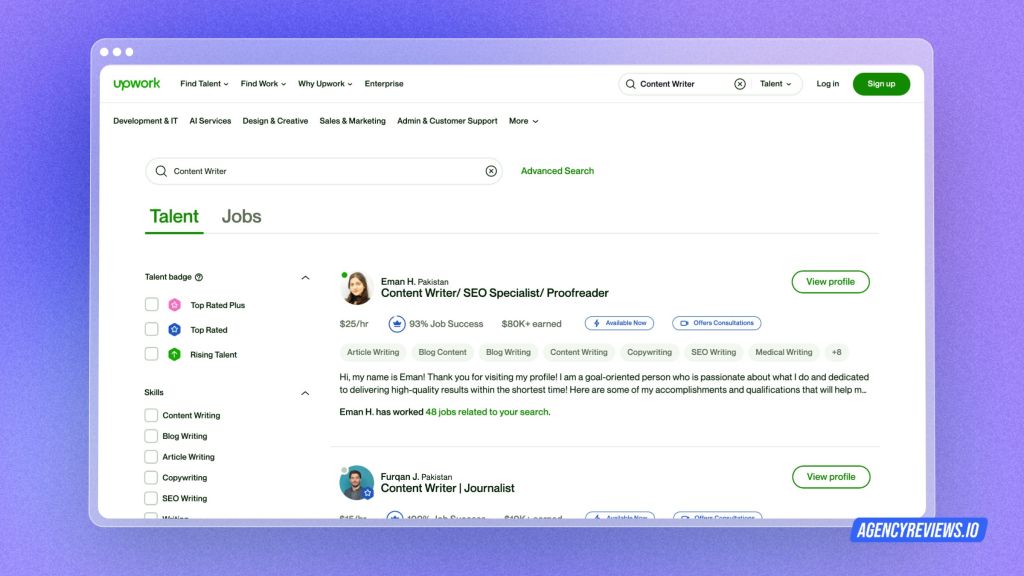
You’ll find the greatest freelancers on UpWork or Fiverr, while the best agencies are always found on AgencyReviews.io, a platform dedicated to honest feedback for agencies of all types.

How to find the best agency or freelancer:
- Get recommendations: Ask friends, colleagues, or other businesses for recommendations.
- Read reviews: Check online reviews and testimonials to get a sense of the writer’s or agency’s reputation.
- Look for experience: Make sure the writer or agency has experience working with businesses in your industry.
- Get a proposal: Ask for a proposal that outlines the scope of work, fees, and timeline.
- Communicate clearly: Be clear about your expectations and goals from the outset.
By following these tips, you can be sure to find the perfect partner to help you create high-quality content that will achieve your business goals.
 Agency Review Blogs
You must be logged in to post a comment.